Eco•Laboratory
Seattle, Washington
Location
Neighborhoods, Gather + Culture
Project type
Concept Design,
Planning + Architect
Role
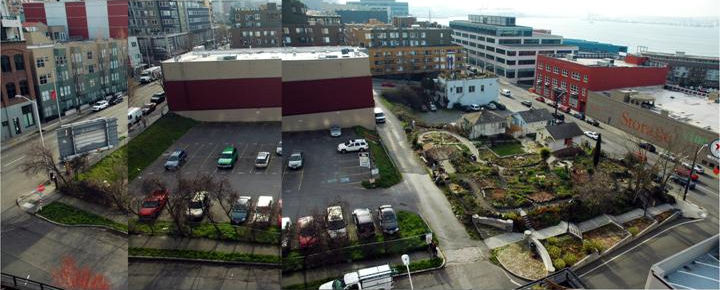
Eco•Laboratory is an award-winning living building concept envisioning a regenerative, mixed-use eco-district on a tight infill site in Seattle’s Belltown neighborhood. Organized around a vibrant community garden, the project explores how architecture, landscape, and building systems can work together as a single, integrated framework—supporting environmental performance, education, and everyday community life.
Challenge
The project site, a 7,200-square-foot urban P-Patch, was already deeply valued by the surrounding neighborhood, yet underutilized in terms of density, program, and long-term viability. The challenge was to significantly increase use and intensity without erasing the site’s identity, while meeting the rigorous demands of the Living Building Challenge. The design needed to balance mixed-use development, community stewardship, and financial feasibility, all within a constrained urban footprint.
Solution
Eco•Laboratory proposes a layered, mixed-use development that preserves and amplifies the existing community garden as the heart of the site. Residential units, office space, a neighborhood market, a vocational training center, and a sustainability education hub are woven together around shared outdoor and interior green spaces. Three historic cottages are retained and repurposed as writers-in-residence, reinforcing the cultural and social dimension of the project. Landscape is extended vertically and inward, blurring the boundary between building and garden while making environmental systems visible and accessible to occupants and visitors alike.
Materials + Craft
Material choices and construction strategies emphasize reuse, legibility, and long-term performance. Demolition waste is reused on site, while primary living modules are constructed from repurposed shipping containers. Concrete walls incorporate fiber-optic aggregates that reveal embedded building systems and pull daylight deep into interior spaces. Passive strategies—including Earth Tubes for natural ventilation and stack-effect cooling—are paired with on-site renewable energy generation through solar, wind, biofuel, and hydrogen systems. Water is captured, treated, and reused through organic filtration and aquatic ecosystems, supporting occupants, indoor vegetation, and the surrounding gardens. Throughout the project, beauty is expressed not only through form, but through the clarity of systems, the experience of place, and the enduring relationship between people, building, and environment.